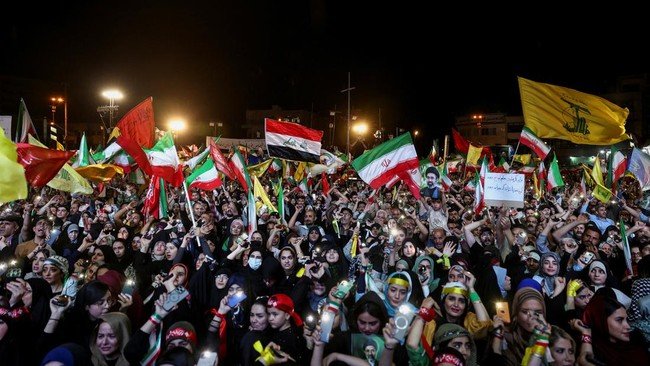
Lintasnusa.com – The streets outside Iran’s Foreign Ministry offices became an unexpected stage for political dissent on Saturday as dozens of demonstrators gathered in several cities to denounce comments attributed to senior Iranian diplomat Abbas Araghchi regarding the prospect of a peace or diplomatic agreement with the United States. While the scale of the demonstrations remained relatively limited, the symbolism behind the protests revealed a deeper and more consequential struggle unfolding within the Islamic Republic: the battle between pragmatists seeking diplomatic engagement and hardline factions determined to resist any perception of compromise with Washington.
Thank you for reading this post, don't forget to subscribe!Footage circulated by Iran’s semi-official Fars News Agency showed groups of protesters, many of them women dressed in black chadors, chanting slogans against Araghchi outside a Foreign Ministry building in Mashhad. Demonstrators reportedly shouted, “Death to the dishonorable Araghchi, the infiltrator,” while waving black and red flags associated with revolutionary and religious symbolism.
The protest was not merely a reaction to one official’s remarks. Rather, it represented a manifestation of broader anxieties within segments of Iranian society and the political establishment over the future direction of the country’s foreign policy at a moment of heightened regional tensions, economic uncertainty, and shifting geopolitical calculations.
A Diplomatic Comment That Sparked a Political Storm
In many countries, statements regarding negotiations with a foreign power might generate debate among policymakers and media commentators. In Iran, however, the issue carries far greater ideological weight.
Relations between Tehran and Washington have been defined by nearly half a century of hostility since the 1979 Islamic Revolution. The seizure of the U.S. Embassy in Tehran, decades of sanctions, military confrontations through proxies, and disputes over Iran’s nuclear program have entrenched mutual distrust.
Against this historical backdrop, any suggestion that Iran could move toward a significant agreement with the United States often triggers intense reactions from political factions that view resistance to American influence as a cornerstone of the Islamic Republic’s identity.
Reports indicating that Araghchi spoke positively about the possibility of an agreement or diplomatic arrangement with Washington quickly became a lightning rod for criticism among hardline activists. To these groups, engagement with the United States is not merely a policy choice but an ideological red line.
Their response reflects longstanding concerns that negotiations could weaken Iran’s revolutionary principles, reduce its strategic leverage, or lead to concessions viewed as unacceptable by conservative political and religious constituencies.
Who Is Abbas Araghchi?
Abbas Araghchi is not a newcomer to Iranian diplomacy. Over the past decade, he has emerged as one of the most recognizable faces of Iran’s foreign policy apparatus, particularly during negotiations over the country’s nuclear program.
Known for his experience in international diplomacy and his role in talks with world powers, Araghchi has often been associated with pragmatic approaches aimed at reducing tensions while preserving Iran’s strategic interests.
His reputation among supporters is that of a skilled negotiator capable of navigating complex geopolitical disputes. Critics, however, especially among hardline circles, have occasionally portrayed him as too willing to engage with Western governments.
The latest controversy appears to fit into this longstanding pattern, where diplomatic outreach is interpreted by opponents as a sign of weakness or ideological compromise.
Why the United States Remains a Sensitive Issue
The reaction to Araghchi’s remarks cannot be understood without examining the unique place the United States occupies in Iran’s political discourse.
For decades, anti-American sentiment has served as both an ideological pillar and a mobilizing force within sections of the Iranian establishment. Official rhetoric frequently frames Washington as a hostile actor seeking to undermine Iran’s sovereignty through sanctions, military pressure, and political interference.
This narrative has been reinforced by a series of real-world confrontations, including:
- U.S. economic sanctions targeting Iran’s economy.
- Disputes over Tehran’s nuclear activities.
- Military incidents in the Persian Gulf.
- The killing of senior Iranian military commander Qassem Soleimani in 2020.
- Ongoing regional rivalries involving U.S. allies.
As a result, proposals for engagement with Washington often face skepticism, even when economic realities suggest diplomacy could offer significant benefits.
Many hardliners argue that previous attempts at negotiation failed to produce lasting results and instead exposed Iran to additional vulnerabilities.
Economic Pressures Driving Calls for Diplomacy
Despite ideological resistance, there are strong incentives pushing Iran toward diplomatic engagement.
Years of sanctions have severely constrained economic growth, weakened the national currency, increased inflation, and reduced foreign investment. Ordinary Iranians continue to face rising living costs and declining purchasing power.
These economic challenges have intensified public debates about whether continued confrontation with the West remains sustainable.
Pragmatic policymakers argue that reducing tensions with Washington could help unlock economic opportunities, facilitate trade, and improve living standards. They contend that diplomacy should be viewed as a tool for advancing national interests rather than an abandonment of revolutionary values.
This perspective has gained traction among segments of Iran’s political elite who believe economic stability is becoming increasingly important for maintaining domestic legitimacy.
The protests against Araghchi therefore highlight a fundamental tension between ideological commitment and economic pragmatism.
Symbolism of the Mashhad Demonstration
Although the protests involved only dozens of participants, their location and imagery carried considerable political significance.
Mashhad is one of Iran’s most important religious cities and has long been regarded as a stronghold of conservative and revolutionary sentiment. Demonstrations emerging from such a location often resonate beyond their numerical size.
The black and red flags displayed by protesters evoke themes of martyrdom, resistance, and religious devotion deeply embedded in Iran’s political culture.
Likewise, the chants accusing Araghchi of being an “infiltrator” reflect a common accusation used by hardline groups against individuals perceived as being too accommodating toward Western powers.
The language suggests that critics are not simply questioning policy choices but are framing the issue as one of loyalty and ideological integrity.
Such rhetoric can be particularly powerful in Iran’s political environment, where debates frequently involve questions of revolutionary identity rather than purely strategic considerations.
Internal Divisions Becoming More Visible
The demonstrations also underscore the increasingly visible divisions within Iran’s political establishment.
While Iran often presents a unified front internationally, internal debates over foreign policy have intensified in recent years.
Broadly speaking, three competing perspectives can be identified:
The Hardline Position
This camp argues that resistance has preserved Iran’s independence and regional influence. Supporters believe negotiations with the United States are unlikely to produce meaningful benefits and could undermine national sovereignty.
The Pragmatic Position
Pragmatists favor selective engagement aimed at reducing economic pressures and improving Iran’s international standing. They emphasize practical outcomes over ideological symbolism.
The Strategic Middle Ground
A third group supports negotiations but only from what it considers a position of strength. These figures advocate diplomacy while insisting on strict safeguards to prevent concessions viewed as excessive.
Araghchi’s comments appear to have reignited tensions among these competing factions.
Regional Context Matters
The controversy arrives at a particularly sensitive moment for the Middle East.
The region has experienced significant geopolitical shifts over the past several years, including:
- The normalization of relations between Israel and several Arab states.
- Renewed diplomatic engagement between Iran and Gulf countries.
- Ongoing conflicts involving regional proxy groups.
- Continued uncertainty regarding Iran’s nuclear program.
- Changes in U.S. strategic priorities in the Middle East.
These developments have forced Tehran to reassess aspects of its foreign policy strategy.
Some officials see diplomacy as an opportunity to strengthen Iran’s position amid evolving regional dynamics. Others fear that engagement with Washington could reduce Iran’s leverage or embolden adversaries.
Artikel Terkait : Presiden Prabowo Evaluasi Program Makan Bergizi Gratis: Antara Ambisi Besar, Masalah Tata Kelola, dan Tuntutan Perbaikan Menyeluruh
The protests against Araghchi therefore reflect concerns extending far beyond a single diplomatic statement.
Social Media Amplifies Political Tensions
Another notable aspect of the controversy is the role of digital platforms in accelerating public reactions.
Video clips from the demonstrations quickly circulated across social media networks, reaching audiences far larger than those physically present at the protests.
In today’s political environment, even relatively small gatherings can generate significant national attention when amplified online.
Supporters of engagement and opponents of diplomacy alike have used social media to frame the narrative surrounding Araghchi’s remarks.
For hardliners, the videos serve as evidence of grassroots resistance to rapprochement with the United States.
For pragmatists, the protests may be interpreted as a coordinated effort by ideological factions seeking to limit policy flexibility.
The battle for public opinion increasingly unfolds in digital spaces where symbolism often matters as much as substance.
What the Protests Mean for Iran’s Foreign Policy
The immediate impact of the demonstrations is likely to be political rather than operational.
Iran’s foreign policy is ultimately shaped by a complex decision-making structure involving multiple institutions and senior leaders. Street protests alone are unlikely to determine strategic outcomes.
However, such demonstrations can influence the political atmosphere in which decisions are made.
By publicly criticizing Araghchi, hardline activists may be attempting to signal opposition to any future diplomatic initiative involving Washington. Their goal could be to raise the political cost of engagement and constrain negotiators before substantive talks even begin.
At the same time, the protests highlight the challenges facing Iranian officials who seek to balance economic necessity with ideological expectations.
Any future agreement with the United States would likely encounter intense scrutiny from domestic constituencies skeptical of American intentions.
A Test of Iran’s Political Direction
The backlash against Abbas Araghchi ultimately reflects a larger question confronting Iran: should the country continue prioritizing ideological resistance as the central framework of its foreign policy, or should it pursue a more pragmatic approach focused on economic recovery and diplomatic flexibility?
The answer remains uncertain.
Iran’s leadership must navigate competing pressures from hardline activists, economic realities, regional developments, and public expectations. Each factor pulls policy in a different direction.
The demonstrations in Mashhad and other cities may not represent a nationwide movement, but they offer a glimpse into the ideological battles shaping Iran’s future.
For supporters of diplomacy, the protests illustrate the obstacles that remain to any significant breakthrough with Washington.
For opponents, they serve as a warning that engagement with the United States continues to be viewed by many as a challenge to the principles on which the Islamic Republic was founded.
As debates over Iran’s foreign policy intensify, the controversy surrounding Araghchi demonstrates that the struggle between pragmatism and ideology remains one of the defining forces in Iranian politics. Whether Tehran ultimately moves toward accommodation or confrontation, the reactions witnessed this weekend suggest that any path forward will be contested, emotionally charged, and closely watched both at home and abroad.